Views: 0 Author: Site Editor Publish Time: 2026-09-15 Origin: Site


Selecting the wrong hardware for a sofa line can quickly lead to structural failure, floor damage complaints, and costly product returns. Consumers expect flawless performance every single day. They demand furniture capable of withstanding rigorous, long-term use. For furniture manufacturers, hardware procurement isn't just about aesthetics; it requires a strict evaluation of load-bearing geometry, material metallurgy, and finish durability. Overlooking these engineering realities often triggers cascading failures. These issues range from wobbly frames to badly tarnished metal surfaces. This guide provides a technical and operational framework for evaluating and shortlisting metal sofa legs for high-volume manufacturing. You will learn exactly how to align base materials with target climates. We will teach you how to verify structural integrity reliably. We will also explore advanced surface finish testing protocols. Finally, you will discover strict quality control standards for vetting global suppliers.
Material dictates lifespan: Match the base metal (steel, aluminum, alloy) to the destination market's climate (humidity and salt exposure).
Geometry impacts stability: Specific designs distribute weight differently; assess the mounting plate thickness and weld points.
Finishes require testing: Demand salt-spray test reports for plated finishes to ensure batch-to-batch consistency.
Supplier capability is critical: Evaluate potential partners on their quality control (QC) processes, minimum order quantities (MOQs), and defect replacement policies.
Manufacturers must first evaluate the underlying metal types. The raw material dictates both the strength and environmental resistance of the final product. Carbon steel offers a highly cost-effective and strong solution. Many manufacturers prefer it for heavy-duty furniture designs. However, carbon steel requires superior coating processes to prevent oxidation over time. Raw iron alloys will rust rapidly if exposed to moisture.
Stainless steel serves as the gold standard for high-end applications. We usually compare 304 and 316 grades during procurement. Grade 304 handles most indoor environments exceptionally well. Grade 316 provides superior resistance for extreme marine climates. Stainless steel resists corrosion naturally, making it ideal for humid environments.
Aluminum alloy presents another excellent option. It remains lightweight and naturally corrosion-resistant. Utilizing aluminum helps manufacturers achieve significant shipping weight reduction. However, aluminum generally supports less extreme point-loads compared to steel. You must engineer the internal structure carefully to compensate for this lower yield strength.
The destination market's climate must always dictate your material choice. Coastal environments accelerate rust on poorly sealed iron components. Salt air penetrates microscopic cracks in cheap coatings. This leads to galvanic corrosion and eventual structural failure. A dry climate might forgive a minor coating flaw. A humid, coastal climate will expose it within months. You must map your hardware materials directly to the environmental realities of your target demographic.
Sofa foundations face complex physical stresses daily. Standard sofas require legs capable of handling dynamic loads. Dynamic loads represent shifting human weight. When someone drops onto a cushion, force multipliers spike dramatically. The hardware must absorb this sudden impact. You cannot simply calculate static loads. A leg might hold 200 pounds of static pressure easily. It could still fail under 150 pounds of dynamic, lateral force.
Geometry heavily influences overall design stability. You must evaluate how specific leg shapes affect weight distribution. Certain profiles naturally resist bending better than others. For instance, utilizing triangle metal sofa legs provides a much wider stance. This specific geometry delivers superior shear-force resistance compared to standard straight pins. It spreads the downward pressure across a broader surface area.
Mounting plate thickness requires close inspection. Assess the exact gauge of the top mounting plate. A thin plate will warp under heavy use. Warping pulls the screws out of the wooden sofa frame. We recommend a minimum thickness of 2.5mm for heavy seating units.
You must also check weld integrity meticulously. Look for continuous, slag-free welding at the critical joint. This joint connects the vertical leg to the horizontal plate. Spot welds often break under lateral stress. A full-penetration robotic weld ensures maximum longevity. This joint remains the most common point of failure in poorly manufactured furniture.
Leg Geometry | Load Distribution | Shear-Force Resistance | Best Application |
|---|---|---|---|
Straight Pin (Tubular) | Highly localized (Point load) | Low to Medium | Lightweight accent chairs |
Triangular / V-Shape | Broad (Multi-point distribution) | High | Heavy sectional sofas |
U-Shaped Sled | Linear (Full depth distribution) | Very High | Modern minimalist couches |
Tapered Square | Moderate localized | Medium to High | Standard 3-seater sofas |
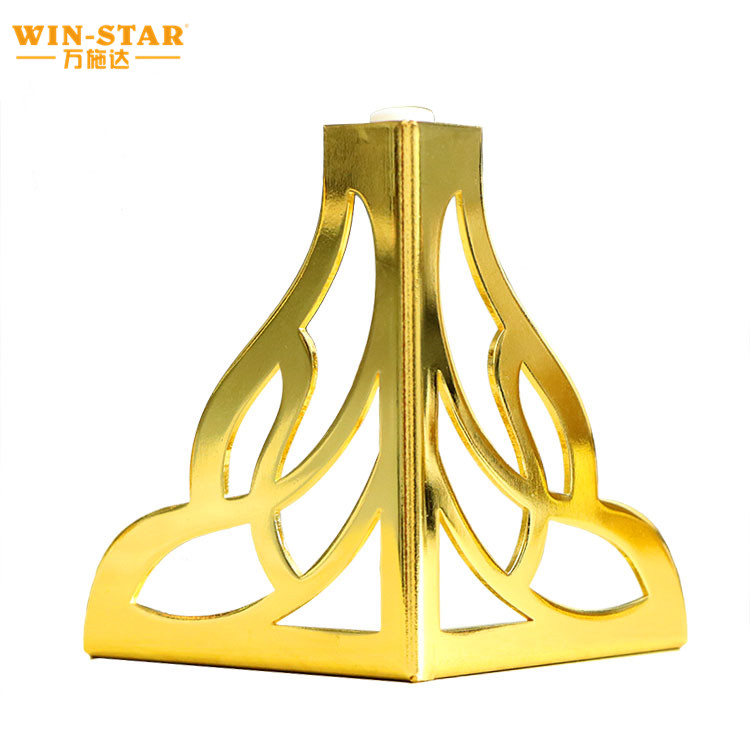
The exterior finish protects the underlying metallurgy. Manufacturers typically choose between two primary coating methodologies. Electroplating provides a high gloss and incredibly precise finish. It binds metal ions directly to the substrate. Powder coating offers a thicker, highly durable alternative. Powder coats remain exceptionally cost-effective for large production runs. They resist chipping better than standard wet paint.
Managing high-demand aesthetics requires strict oversight. Trend-driven components often face the highest consumer scrutiny. When sourcing highly visible items like modern sofa legs, you must verify color consistency. Batch-to-batch color variations will ruin a matching furniture set. Variations often stem from temperature fluctuations in the supplier's plating baths. You should require visual boundary samples before approving mass production.
Certain luxury finishes require rigorous durability validation. For specific finishes like gold sofa legs, you must demand standard testing metrics. Request cross-hatch adhesion test reports. These tests confirm the plating bonds securely to the base metal. You should also mandate 48-to-96-hour salt spray tests. This guarantees the plating will not tarnish. It ensures the finish will not flake off during standard household cleaning.
Common mistakes occur when buyers accept finishes based purely on visual appeal. Always review the independent laboratory data. A beautiful finish means nothing if it oxidizes within six months of delivery.
Manufacturers must proactively mitigate potential customer complaints. Floor damage ruins brand loyalty instantly. The number one end-user objection to metal furniture legs involves floor safety. Consumers fear scratching expensive hardwood floors. They worry about tearing delicate carpets. You must engineer floor protection directly into the product base.
Integrated glides and foot pads solve this problem effectively. Evaluate the bottom of every leg design carefully. Does the product include high-density polymer glides? Nylon and thick rubber pads also offer excellent protection. Soft rubber works well for hard floors. Smooth nylon glides better over thick carpeting. Match the glide material to your primary demographic's flooring trends.
Attachment methods matter just as much as materials. Check how the manufacturer fastens the foot pad. Mechanically fastened pads use threads or rivets. These remain securely attached for decades. Merely glued pads present a massive quality risk. Glue often fails due to ambient room heat. Glued pads will slide off when users drag the sofa. Always specify mechanically fastened floor protectors for heavy furniture pieces.
Best practices dictate requesting sample legs and dragging them across various flooring mockups. This physical testing quickly reveals any friction issues or glide detachment risks before mass production begins.
Finding a reliable manufacturing partner requires a structured approach. B2B procurement relies heavily on verifiable data. You cannot afford supply chain disruptions caused by poor hardware quality. You must evaluate suppliers on technical competence and operational scale.
Start by requesting official certifications and testing data. Does the supplier provide documented ISO 9001 certifications? Can they produce independent material testing reports? These documents prove they maintain standardized quality management systems.
Dimensional tolerance capabilities serve as another critical vetting metric. Assess their precision machining limits closely. A height variance of even 2mm across four legs will cause a sofa to wobble. Wobbling places immense stress on the internal wooden frame. It ultimately leads to premature structural failure.
You must also clarify daily supply chain realities.
Define explicit Minimum Order Quantities (MOQs) upfront.
Map out standard production lead times realistically.
Determine exact defect replacement policies and timelines.
Audit their specific packaging and shipping methods.
Mandate individual wrapping to prevent metal-to-metal transit scratches.
Bulk packing metal components without separation guarantees heavy scratch damage. The legs will grind against each other during ocean transit. Individual polyethylene bags or foam sleeves represent a non-negotiable requirement for high-gloss items.
Sourcing the right metal hardware balances aesthetic appeal with strict engineering realities. You must align your metallurgical choices with destination climates. You must engineer geometries to handle dynamic, shifting loads. Protecting the end-user's floors ensures brand loyalty and minimizes costly returns. Vetting suppliers thoroughly guarantees consistent production quality.
Take immediate action on your next procurement cycle. Always request physical production samples before integrating a new leg style into your Bill of Materials (BOM). Never rely solely on prototype models. Conduct rigorous in-house load testing and moisture exposure tests on these physical samples. Building a reliable sofa begins by securing a flawless foundation.
A: Yes, they generally offer superior performance. Compare the yield strength of both materials. Metal offers a significantly higher strength-to-weight ratio. This allows manufacturers to create slimmer, minimalist designs. You achieve modern aesthetics without ever sacrificing load capacity or structural integrity.
A: You must specify the correct metallurgy and coating. We highly recommend using 304 or 316 stainless steel for coastal areas. If using carbon steel, ensure the options have undergone zinc-plating. Apply a high-grade powder coat directly over this zinc layer for maximum protection.
A: Industry baselines dictate strict weight minimums. A standard 4-leg configuration should comfortably support a minimum static load of 600 to 800 lbs. This baseline factors in a necessary safety margin. It accounts for dynamic impacts caused by multiple people sitting down simultaneously.

| | Address: A1 No.277 HeFu Road,Fuwan Industry Area,Gaoming District,Foshan City,Guangdong,P.R.China |
| | 86-13928225189 |
| | Working Time: Mon–Sat: 08:30–18:00 |
| | E-mail: Lisa@fswinstar.com |


