Views: 0 Author: Site Editor Publish Time: 2026-10-06 Origin: Site


Traditional under-bed drawers waste critical floor clearance in small spaces. They often fail to accommodate bulky, seasonal items effectively. Meanwhile, standard platform beds leave valuable square footage entirely unused. When space feels extremely tight, clutter quickly takes over your bedroom environment. You need a reliable way to reclaim that wasted area.
A lifting bed frame mechanism transforms the entire footprint of a mattress into fully accessible, vertical-lift storage. You gain massive organizational capacity without requiring any additional floor space to pull storage drawers open. However, choosing between a DIY retrofit kit or a pre-assembled hydraulic bed requires careful planning.
You must thoroughly understand weight ratings, strut mechanics, and structural safety limits before proceeding. Making the correct choice prevents sudden system failure or expensive mattress damage. We will break down exactly how these hardware components function. You will learn how to properly calculate your physical load. We will also guide you through the strict structural requirements needed for a secure installation.
Pneumatic gas struts are the industry standard for safe, controlled lifting, outperforming traditional spring-based systems in longevity and weight management.
Selecting the correct mechanism requires an exact calculation of your mattress plus the frame weight; overpowered struts won't close, while underpowered ones will slam shut.
A dedicated slatted lift bed frame provides necessary breathability for mattresses while maintaining the structural rigidity required for hydraulic tension.
Proper installation hinges on precise mounting geometry; a millimeter of misalignment severely degrades the lifting capacity and lifespan of the mechanism.
Understanding the hardware powering your storage bed is essential for long-term safety. Manufacturers primarily use two different types of lifting technology. Let us explore why one vastly outperforms the other in daily use.
Modern beds rely on pneumatic cylinders filled with compressed nitrogen gas. These cylinders provide a remarkably consistent, controlled lift. They also enable a gentle soft-close action, preventing accidental slams. A high-quality gas lift bed mechanism easily handles exceptionally heavy memory foam or natural latex mattresses. The internal gas pressure remains highly stable throughout the entire lifting stroke. This physical stability eliminates jerky movements or sudden drops. Furniture engineers consider pneumatic systems the undisputed gold standard for residential and commercial use.
Some budget-friendly manufacturers still utilize basic tension springs. We recommend avoiding them for heavy-duty applications. Springs experience a steep and rapid degradation curve. Metal fatigue causes them to lose critical tension over time. As they age, they require significantly more manual effort to open. More alarmingly, aging tension springs tend to snap unexpectedly under high loads. A snapped spring poses a severe physical hazard to anyone actively accessing the storage compartment below.
Lifting a massive king-sized mattress seems impossible for one person, yet these mechanisms make it feel effortless. They achieve this through kinematic pivot points. The heavy steel brackets essentially shift the bed's center of gravity backward toward the headboard. They transfer the immense physical load directly into engineered pivot joints rather than your lower back. This intelligent lever design allows a single user to lift well over 100 pounds of mattress weight with minimal physical exertion.
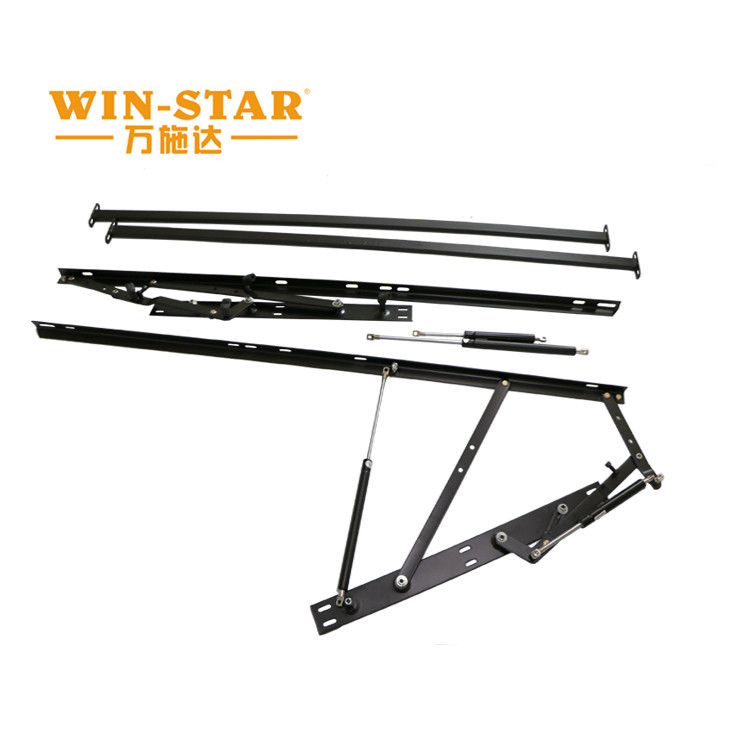
You simply cannot mount heavy-duty lifting hardware onto weak or flimsy frames. The torque generated during the lifting motion will destroy substandard materials. Let us evaluate structural compatibility thoroughly.
Most successful installations utilize a specific base style. A dedicated slatted lift bed frame proves critical for two main reasons. First, the open slats drastically reduce the overall frame weight you must lift. Second, slats provide essential breathability for your mattress. Trapped moisture beneath a mattress quickly breeds mold, making airflow non-negotiable. Furthermore, these bases feature a robust metal perimeter frame. This outer steel ring prevents the interior wood components from bowing or warping under extreme hydraulic strut tension.
DIY builders frequently adapt these lift systems for non-traditional spaces. Modifying a folding sofa bed frame or a custom RV platform requires advanced planning. You must implement custom structural reinforcement at every mounting plate. Standard furniture wood cannot handle the immense torque generated when pulling the mattress down. If you fail to add steel backing plates or thick hardwood blocks, the brackets will inevitably bend or tear straight out of the frame.
Your room dimensions dictate the specific hardware you can install. The length of the lifting arms directly correlates to your maximum access angle.
Short Arms (Approx. 3 feet): Typically open to a shallow 30-degree angle. They work well in rooms with very low ceilings but make reaching items near the headboard difficult.
Long Arms (Approx. 5 feet): Usually open closer to a generous 45-degree angle. They offer exceptional access to the entire storage bay.
Evaluate your ceiling height, hanging light fixtures, and your own physical reach constraints before selecting an arm length.
Purchasing the wrong strut power guarantees a miserable user experience. You must match the cylinder strength precisely to your specific bed load. Let us examine how to read and apply these engineering specifications correctly.
Hardware manufacturers rate gas struts in Newtons (N). To determine the rough equivalent in pounds, remember that 100 Newtons equals approximately 22.5 pounds of lifting force. Because you install these struts in pairs, you double the combined lifting power.
Standard Gas Strut Force Rating Guide
Strut Rating (Per Cylinder) | Approximate Total Lift Force (Pair) | Typical Mattress Application |
|---|---|---|
400N | ~180 lbs | Twin / Light Full (Foam) |
600N | ~270 lbs | Full / Queen (Standard Spring) |
800N | ~360 lbs | Queen (Heavy Foam) / King |
1000N+ | ~450+ lbs | King (Latex or Extra Thick) |
Mismatching your struts creates a critical daily failure risk. You must respect the weight matching rule.
Too strong: If you install 1000N struts on a lightweight twin bed, the bed will literally float. The gas pressure overpowers the mattress weight, causing the frame to refuse to stay closed. You will battle the bed every night just to lay flat.
Too weak: If you put 400N struts under a massive king latex mattress, the bed acts like a guillotine. It simply will not hold the open position. It will crash down while you rummage through your storage bins.
A common DIY mistake involves calculating requirements based solely on the bare mattress weight. You must aggressively account for your bedding. Always factor in the weight of your sheets, heavy winter duvets, decorative pillows, and mattress protectors. Premium winter bedding easily adds 15 to 30 extra pounds to your total lift load. Calculate your required force for the bed lift mechanism using the fully dressed bed, not the naked mattress.
Even the finest hardware fails if you install it poorly. Achieving a safe, reliable lift requires absolute exactness during the mounting phase.
DIY installations demand strict adherence to geometry. The distance from the headboard directly dictates your mechanical leverage. The angle of the mounting bracket dictates exactly how the strut compresses when closed. A single millimeter of misalignment severely degrades the lifting capacity. Poor geometry forces the cylinders to bind against their housings, causing premature wear and terrible lifting performance.
These brackets pull intensely against the frame material. We strongly warn against mounting high-tension brackets directly into MDF or thin particleboard. These composite materials possess virtually no structural pull-out strength. The mounting screws will violently rip out under tension, destroying the bed. Always use solid wood reinforcement blocks. For maximum safety, utilize thick steel backing plates and through-bolts secured with nylon lock nuts.
Prioritize safety features when evaluating different hardware kits. Look for mechanisms featuring manual locking pins. Better yet, find models with automatic integrated safety catches. These mechanical failsafes prevent accidental closure if a gas strut suddenly fails while you retrieve active storage. They offer vital peace of mind, especially in households with children or pets.
Set realistic expectations regarding lifespan. A high-quality gas strut typically lasts 5 to 7 years under daily, rigorous use. Over time, the internal seals wear down. You should visually inspect the metal cylinder shafts every few months. If you spot a greasy, oily residue collecting on the shaft, you have weeping seals. Weeping seals indicate that the internal compressed nitrogen gas is escaping. You must replace the cylinders immediately to avoid a sudden drop.
You must decide between purchasing a fully integrated bed or building one yourself. Consider your skill level, budget, and risk tolerance carefully.
Factory-built lift beds present the lowest risk. They are best for users who prioritize manufacturer warranties and guaranteed weight-matching. Engineers have already perfectly calculated the strut strength for the included slatted base. You enjoy seamless aesthetic integration with zero guesswork. The primary drawback is the higher upfront cost. However, everything simply works flawlessly straight out of the box.
Retrofit kits appeal to budget-conscious buyers who possess advanced carpentry skills. They excel when you need custom dimensions for RVs, tiny homes, or custom cabinetry builds. You achieve total customization at a much lower hardware cost. However, you accept a significantly high risk of error. You bear full responsibility for structural reinforcement, geometry calculations, and safety testing.
Before making any purchase decision, gather hard data. First, locate your mattress manufacturer's weight specifications online, or weigh it yourself using a heavy-duty scale. Second, measure your room's exact vertical clearance to the ceiling or light fixtures. Third, estimate your heaviest winter bedding weight. Use these concrete numbers to guide your final choice.
Transforming your bedroom with under-bed storage requires more than just buying random hinges. You must treat a lifting bed frame mechanism as a sophisticated engineered hardware solution, rather than just a simple convenience feature. Successful implementation relies entirely on three critical factors: accurate weight calculation, solid mounting substrates, and high-quality gas struts.
Never rush the installation process. Measure your mounting geometry multiple times before drilling any pilot holes. Always reinforce your attachment points with solid wood or steel to prevent catastrophic tear-outs. Ultimately, we strongly encourage buyers to prioritize long-term safety and structural integrity over entry-level pricing. Investing in the right pneumatic hardware ensures years of effortless, secure storage access.
A: Yes, but you must heavily reinforce the frame. Existing wooden beds rarely have the internal structural integrity required to handle intense hydraulic torque. You must install solid wood mounting blocks or steel plates. You also need adequate internal clearance so the lifting arms do not scrape the side rails.
A: End-lift mechanisms raise the mattress from the footboard, providing access from both sides. Side-lift mechanisms raise the mattress from one long side. Side-lifts work perfectly in narrow rooms where you must push the bed firmly against a wall, optimizing tight space constraints.
A: Gas struts require the full counter-weight of the mattress to operate properly. If you test the mechanism while the frame is empty, it will feel impossibly stiff. You must place the heavy mattress on the frame to compress the struts and close the bed safely.
A: Generally, no. As long as you mount the mattress on a proper slatted lift bed frame that provides adequate support spacing (usually slats spaced no more than 3 inches apart), warranties remain intact. Always verify the required slat spacing with your specific mattress manufacturer.

| | Address: A1 No.277 HeFu Road,Fuwan Industry Area,Gaoming District,Foshan City,Guangdong,P.R.China |
| | 86-13928225189 |
| | Working Time: Mon–Sat: 08:30–18:00 |
| | E-mail: Lisa@fswinstar.com |


