Views: 0 Author: Site Editor Publish Time: 2026-10-13 Origin: Site


Have you ever strained your back trying to access under-bed storage? Many people endure this frustrating ordeal simply because their hardware lacks the correct tension. Lifting heavy mattresses should feel effortless, not like an intense physical workout.
Choosing the wrong load capacity transforms a convenient storage solution into a safety hazard or an unusable bed. A lifting bed frame mechanism must precisely match the combined weight of your mattress, base, and bedding. Guessing leads to two failure states: a bed that requires dangerous physical force to lift (under-capacity) or a bed that refuses to stay closed (over-capacity).
This guide provides a clinical framework for calculating your exact load requirements and evaluating hardware grades. We will explore how to translate mattress weights into accurate pneumatic force ratings. By the end, you will confidently shortlist a mechanism guaranteeing smooth and safe operation.
Formula for Success: Target Capacity = Mattress Weight + Base/Slats Weight + Bedding Weight + 10% Safety Margin.
Newton (N) Ratings Matter: Gas struts are measured in Newtons; a standard Queen memory foam bed typically requires 900N–1200N of force, whereas lighter frames need significantly less.
Over-Speccing is a Flaw: Buying the highest capacity available is a common mistake; excess pressure will prevent the bed from closing fully or resting flat.
Material Integrity: High load capacities require cold-rolled steel brackets (minimum 3mm thickness) to prevent warping under continuous tension.
Hardware tension relies on exact physics. Ignoring these calculations invites immediate problems. A mismatched system degrades user experience instantly.
Failure State 1: Under-Capacity (The "Struggling to Lift" Problem)
Weak pneumatic cylinders fail to support the mattress weight. Users must physically hoist heavy loads. This action places severe strain on the lower back. It introduces serious ergonomic risks for daily users. Furthermore, hardware failure accelerates rapidly. The internal seals of under-specced cylinders blow out under constant overload.
Failure State 2: Over-Capacity (The "Trampoline" Effect)
Many buyers assume stronger mechanisms offer better performance. This assumption causes the "trampoline" effect. The bed lift mechanism exerts too much upward force. Users must forcefully hold the bed down just to sleep. In extreme cases, the frame spontaneously pops open. It refuses to lay flat, rendering the bed useless.
Longevity and ROI
Matching the load correctly protects your investment. High-quality gas struts boast specific lifecycle ratings. They typically endure 10,000 to 50,000 cycles. Operating within the intended weight limits prevents premature seal degradation. It ensures long-term reliability and eliminates sudden pneumatic failures.
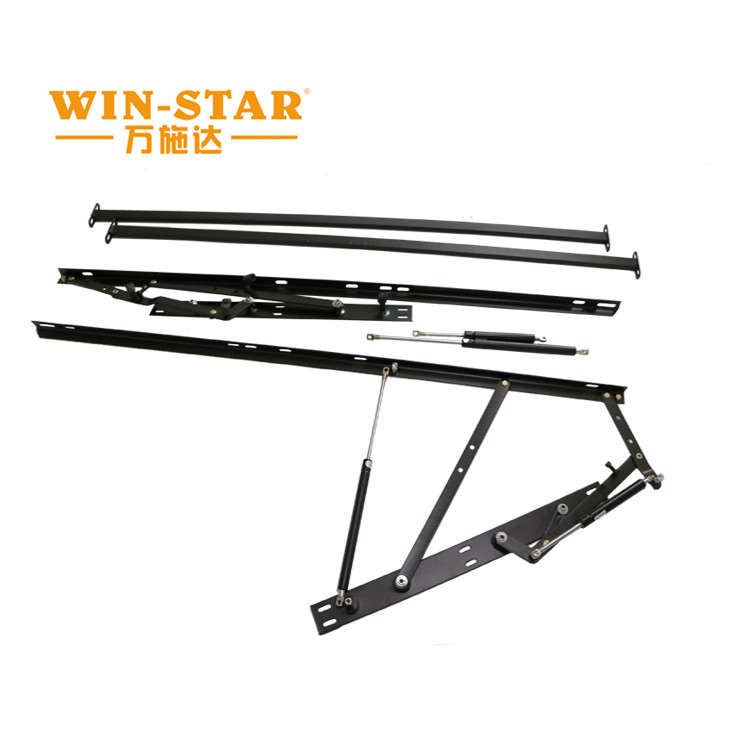
Guesswork has no place in pneumatic hardware installation. You must calculate the aggregate weight of your entire sleeping platform. We recommend following a strict three-step framework.
Step 1: Baseline Mattress Weight. Material compositions vary wildly. Traditional inner-spring mattresses remain relatively light. Conversely, dense latex or king-size memory foam models weigh much more. Some modern premium mattresses easily exceed 100 lbs (45 kg). Check the manufacturer tag for exact numbers.
Step 2: Base & Hardware Factoring. You must account for the physical lifting platform. A solid MDF board adds drastic weight to the system. In contrast, a standard slatted lift bed frame remains highly efficient and lightweight. Weigh all wooden components that move upward.
Step 3: The 10% Rule of Thumb. Always add a 10% to 15% safety margin. This buffer accounts for heavy winter bedding. It also absorbs slight manufacturing variances within the cylinder pressure.
Translating Pounds/Kilograms to Newtons (N)
Manufacturers list pneumatic strength in Newtons. You must translate your final weight into this metric. Use a standardized conversion baseline. Approximately 10N equates to 1kg of lift force. If your total calculated weight is 80kg, you need an 800N rating. This simple math helps buyers read technical spec sheets accurately.
Common Mistakes: Do not weigh the static bed frame perimeter. Only calculate the moving components. Including the static frame weight will ruin your Newton calculations.
Selecting the right technology depends heavily on your target load. Different scenarios demand distinct mechanical approaches.
Pneumatic Gas Struts (Manual)
Manual gas struts dominate the residential market. They are best for standard loads up to 150 lbs (68 kg). A high-quality gas lift bed mechanism operates seamlessly. It boasts extreme reliability. It requires zero electricity. However, it demands precise N-rating matching to function safely.
Motorized / Actuator Systems
Some loads exceed safe human operating limits. Motorized actuator systems fit extremely heavy custom beds. They serve commercial hospitality and accessibility needs well. They easily handle loads exceeding 150 lbs. Motorized setups bypass physical user limits entirely. They feature programmable stop limits. However, they introduce points of electrical failure. They also carry a significantly higher upfront cost.
Application-Specific Frames
Not all lifting frames move vertically. For example, a folding sofa bed frame demands different physics. It requires dynamic load shifting calculations. The center of gravity changes as it unfolds. Ensure you specify your exact frame type when sourcing hardware.
Comparison: Mechanism Technology Applications
Technology Type | Ideal Load Range | Primary Advantages | Notable Drawbacks |
|---|---|---|---|
Pneumatic Gas Struts | Up to 150 lbs (68 kg) | No power needed, highly reliable | Requires exact N-rating math |
Motorized Actuators | 150 lbs+ (68 kg+) | Push-button ease, handles extreme weight | Higher cost, risk of power failure |
Dynamic Folding Struts | Variable | Adapts to shifting gravity centers | Complex installation geometry |
A high capacity rating means nothing if the metal fails. You must evaluate the underlying structural specifications. Hardware integrity separates premium solutions from dangerous imitations.
Bracket Steel Thickness
Heavy loads exert massive torque on mounting brackets. Do not accept less than 3mm cold-rolled steel for heavy-duty applications. Thin stamped steel lacks structural density. It will bend outward under lateral torsion. Once a bracket bends, the entire mechanism loses alignment.
Rivet and Hinge Quality
Pivot points bear the most concentrated stress. Look for reinforced, multi-point riveting. Single-point pivot hinges shear quickly under heavy loads. A sheared hinge instantly collapses the elevated bed. Multi-point hinges distribute the kinetic load evenly across the steel plate.
Surface Treatment
Bed bases create closed, low-airflow environments. Moisture easily gets trapped inside these spaces. Standard paint chips and invites rapid rust. Powder-coated finishes resist moisture far better. They provide a durable seal against environmental degradation. Rust compromises both the brackets and the pneumatic cylinder seals.
Mounting Geometry
A 1000N rating assumes perfect installation geometry. The capacity rating remains valid only if installed at the correct angle. Verify that the manufacturer provides distinct structural mounting templates. Proper templates ensure the fulcrum sits precisely where the engineers intended.
Even premium hardware fails if installed incorrectly. Small errors in setup drastically alter structural performance. We see several recurring mistakes during field installations.
Ignoring Leverage Dynamics
Pneumatic lift systems rely on strict leverage ratios. Placing the mechanism too far forward or backward ruins everything. Moving it just two inches alters the perceived load capacity. Installing it too close to the headboard multiplies the required lifting force. Always follow the exact mathematical spacing outlined in the manual.
Mismatched Pairs
Gas struts must work in perfect harmony. You must replace or install them in exact identical pairs. A 600N strut paired with an 800N strut creates asymmetrical tension. This uneven force will permanently warp the wooden bed frame. It also twists the steel hinges, leading to catastrophic failure.
Testing Protocol
People often test components right out of the box. Never test gas struts by compressing them with your bare hands. High-pressure cylinders require the leverage of the fully assembled bed. Compressing them manually is dangerous and nearly impossible. Install them fully before attempting any operational tests.
Best Practices: Always use locking nuts on the pivot bolts. Standard nuts vibrate loose over thousands of opening cycles. A loose nut shifts the fulcrum point and weakens the lift capacity.
Navigating supplier catalogs requires a methodical approach. Vague marketing terms hide inferior engineering. Use this checklist to identify authoritative suppliers.
Verify Certifications: Do not rely on promises alone. Look for ISO quality testing standards. Demand specific cycle-test transparency from the supplier. Quality manufacturers proudly display their testing methodologies.
Warranty Alignment: A 1-year warranty on a gas cylinder acts as a red flag. Pneumatic seals should last much longer. Look for 3-to-5-year guarantees on pressure retention. This shows the factory trusts their internal components.
Vendor Support: Good suppliers remove the guesswork for you. Shortlist suppliers who provide clear Newton-to-Mattress-Weight lookup tables. Avoid brands relying on vague "Heavy Duty" marketing labels. You need exact engineering data, not buzzwords.
Sourcing the right lifting bed frame mechanism remains an exercise in exact math. Estimation inevitably leads to poor performance or broken hardware. By calculating your exact load requirements, you guarantee a safe and effortless user experience.
Remember to weigh your specific mattress, calculate the moving base structure, and add a safety margin. Convert your total lifted weight directly to Newtons. Always scrutinize the steel gauge of the mounting brackets before buying. Never compromise on 3mm cold-rolled steel for primary supports.
Your next step is simple. Strip your bed down and weigh your current mattress and base setup. Once you have your baseline number, consult supplier specification tables to find your exact pneumatic match.
A: Only if the steel mounting brackets and the wooden bed frame are rated for the increased tension. Upgrading struts without upgrading the hinges often rips the screws out of the wood. The entire system must handle the higher load.
A: Look for hydraulic fluid leaks near the cylinder seal. Another clear indicator is a bed that slowly drops after being fully opened. If it requires significantly more physical effort to lift than before, the internal pressure has degraded.
A: The mechanism itself doesn't differentiate. However, a solid wood base consumes a larger percentage of the mechanism's total capacity. This leaves less allowance for a heavy mattress. You must calculate the combined weight of both.
A: Assuming nothing is physically blocking the hinges, the mechanism is likely over-specced. It pushes with too many Newtons for your specific mattress weight. You must swap the struts for a lower load rating to allow it to close.

| | Address: A1 No.277 HeFu Road,Fuwan Industry Area,Gaoming District,Foshan City,Guangdong,P.R.China |
| | 86-13928225189 |
| | Working Time: Mon–Sat: 08:30–18:00 |
| | E-mail: Lisa@fswinstar.com |


